
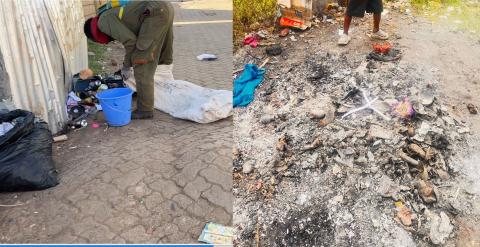
This story investigates how uncontrolled hazardous waste in Dagoreti has created an informal scrap economy that is pulling school-age boys out of classrooms and into dangerous work, exposing them to toxic materials, health risks, and child labour, while weak regulation and poor waste management allow the crisis to spread into homes, schools, and basic infrastructure such as sewage systems.
At eight in the morning in Dagoretti, whilst lessons begin at nearby schools and teachers call out names from class registers, a different routine unfolds behind a row of shops near the main road.
Nine boys, all of school-going age, are gathered at an informal scrap metal yard, bending over piles of burnt electric wires, twisted iron sheets and broken electronics. None of them are in school.
The Gender Desk has established that hazardous waste spreading across Dagoretti has quietly created an unregulated labour market, pulling boys out of classrooms and into scrap yards, dumpsites and burning grounds. All the boys we spoke to have no national identity cards, confirming they are below the legal employment age, yet the uncontrolled circulation of hazardous waste has made informal work both accessible and attractive.
The boys, estimated to be between 10 and 15 years old, spend their mornings collecting scrap metal from small dumpsites in Kawangware, roadsides, construction sites and open drainage channels. They know where to find burnt wires, old electronics and discarded batteries. They know which dealers will pay without asking questions.
They handle burnt electrical wires, leaking batteries, sharp metal fragments and electronic waste that expose them to toxic substances. Yet the risks are normalized because the money is immediate and alternatives are few. Copper fetches the highest price, followed by aluminum and iron, whilst electronic parts are cheaper but easier to find.
By mid-morning, scrap dealers weigh the sorted metal and hand out cash – sometimes enough to buy food for the day, sometimes enough to contribute at home, and sometimes enough to make school feel distant and optional. Several boys admit they now attend school only on certain days, depending on whether there is food at school or whether scrap collection has been good.
Burning wires to extract copper is part of the routine. Small fires are lit behind buildings, along riverbanks or near blocked drainage lines in the Kabiria area. Plastic insulation melts away as thick smoke fills the air. The boys step back briefly, then return to scrape the exposed metal, breathing in fumes they know are harmful but have learnt to accept as part of the work.
Locals say the activity has increased over the past year, largely driven by growing waste volumes and the expansion of informal scrap markets across the area.
Philip Majaiwa, a teacher at Satellite Primary School, says absenteeism amongst boys has become increasingly difficult to manage, with some learners missing entire weeks and others disappearing for long periods before returning withdrawn and significantly behind in their work.
“We are losing boys to scrap yards because the money is immediate and the systems meant to protect them are weak. When a child can earn something every morning, school becomes the harder choice,” Philip said.
He adds that the concern has become so widespread that teachers from several neighboring schools are now discussing a joint effort to keep boys in school – an initiative requiring support from a wider range of collaborators to make any real impact.
This lack of control is producing cascading effects beyond scrap yards. During reporting in Dagoreti, The Gender Desk observed sections of open and underground sewage lines blocked by discarded electronics, metal fragments and burnt wire casings.
Resident Agatha Wanja said the blockages are frequent and often occur after waste is dumped nearby, mixing with soil and household refuse before being washed into drainage channels during rain.
Raw sewage spills onto footpaths and into residential spaces, creating foul smells and heightened health risks.
Hazardous waste in Dagoretti has evolved into a wider crisis, directly affecting education, driving child labour and posing serious public health risks – with each problem reinforcing the other.
Mary Kariuki knows this well. Her son joined the scrap trade after missing school repeatedly since early 2025. At first, she thought the work was temporary and harmless, a way to help the family cope considering she has four other children to feed with no help. Over time, he developed persistent coughing and chest pain, struggling to breathe at night.
She took him to Kivuli Medical Centre, where doctors diagnosed breathing complications linked to prolonged inhalation of smoke from burning copper wires. Mary regrets allowing her son to continue working but admits the decision was shaped by poverty. Food costs money, school costs money, scrap pays immediately.
Erick Kiprop, a clinician at Kivuli Medical Centre, says they increasingly see children with respiratory problems, skin conditions and untreated injuries linked to exposure to hazardous waste.
“Some of these children are collecting scrap themselves, whilst others live near burning sites or blocked drainage channels, so the exposure builds quietly over time until the symptoms become serious,” Kiprop said.
Nyumba Kumi officials in parts of Dagoretti say they are aware of the growing involvement of children in scrap collection and have tried to intervene. They have spoken to parents, warned scrap dealers and discouraged children from working in the yards. However, they admit the scale of the trade and the money involved make enforcement difficult, especially when hazardous waste continues to flow into the area unchecked.
The Gender Desk has also established that one of the scrap metal yards in the area is owned by Agnes Kinyajui, who is a Nyumba Kumi official. Residents said she pays a group of boys to run the business in her absence. Agnes had not responded to questions by the time of publication.
Under the Bamako Convention, African states have committed to strengthen cooperation, information sharing and early warning systems to prevent such waste from reaching communities.
One tool being advanced is the Regional Clearing House Mechanism, designed to improve transparency, data sharing and coordination amongst states on hazardous waste flows. By enabling governments to better track where hazardous waste is generated, how it moves and where it ends up, the mechanism is intended to support timely interventions before waste enters informal markets and residential areas.
Alex Mangwiro, Regional Coordinator for Chemicals, Waste and Air Quality at the United Nations Environment Programme and Programme Management Officer at the Bamako Convention Secretariat, explained that compliance with the Bamako Convention is assessed at the national level by States that are Parties to the Convention and not at the community level.
He clarified that Kenya is not a Party to the Bamako Convention and therefore does not have legal obligations under that instrument. However, he noted that Kenya is a Party to the Basel Convention, which legally binds the country to global obligations on the classification, control and environmentally sound management of hazardous waste, including electronic waste and used batteries.
Mangwiro said that where hazardous waste such as e waste and batteries is openly accessible and traded in informal markets, this reflects gaps in national hazardous waste governance, enforcement capacity and social protection systems rather than failures at the community level. He added that in countries that are Parties to the Bamako Convention, similar challenges have been addressed through stronger national legislation, improved reporting to convention secretariats, enhanced border controls and information sharing through the Regional Clearing House Mechanism, which supports coordinated responses to illegal or unsafe movements of hazardous waste.
In contexts like Dagoretti, where hazardous waste is circulating unchecked and drawing children into risky work, such cooperative mechanisms could play a critical role in aligning national commitments with realities on the ground.